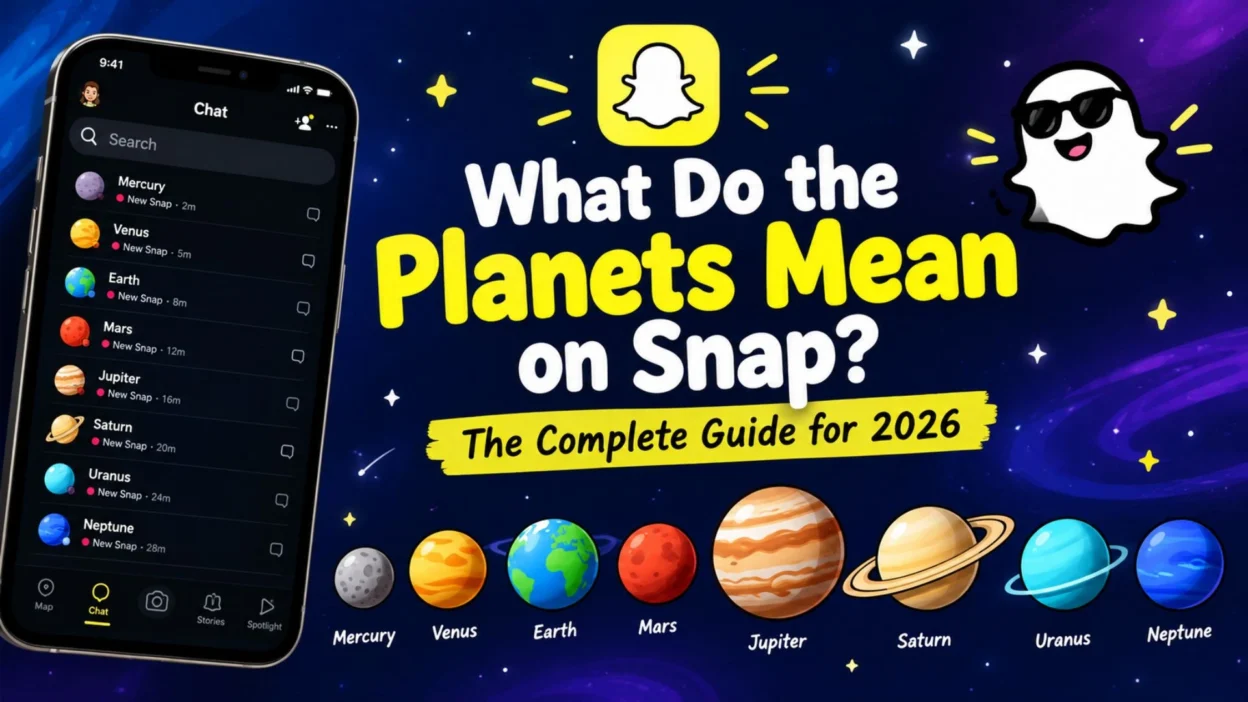
You tap on a friend’s Snapchat profile, see a tiny golden ring around their “Best Friends” badge, and inside it sits a glowing planet. Suddenly you’re staring at Mercury, or maybe Neptune, and you have no idea what it means. Is it a ranking? A badge? A secret code? The truth is that those planets are part of Snapchat’s Friend Solar System, a paid feature that turns your closest friendships into an actual solar system.
In 2026, what do the planets mean on Snap is one of the most searched questions about the app. People want to know where they rank, what each planet represents, and whether being Neptune is as bad as it sounds. This guide explains every planet, how the rankings work, what the symbols around each planet mean, and how to check your own position. By the end, you’ll read those little planets like a pro.
What Do the Planets Mean on Snap: The Quick Answer
This section gives you the fastest possible answer to what do the planets mean on Snap, so you can decode any profile in seconds.
- The planets are part of a feature called Friend Solar System
- You are the Sun at the center of your own solar system
- Eight planets represent your eight closest friends
- Mercury is your number one best friend
- Venus is your second closest friend
- Earth is your third closest friend
- Mars is your fourth closest friend
- Jupiter is your fifth closest friend
- Saturn is your sixth closest friend
- Uranus is your seventh closest friend
- Neptune is your eighth closest friend
- The feature is exclusive to Snapchat+ subscribers
- The ranking is based on how often you interact
- Snaps, chats, and streaks all count toward the ranking
- The planets appear on your friends’ profiles, not yours
- Tapping the badge shows which planet you are in their solar system
- The closer the planet to the Sun, the closer the friendship
- The feature is private and cannot be viewed by others
- It only works on Android and iOS, not on desktop
- The feature is off by default for new subscribers
- You can turn it on or off anytime in Snapchat+ settings
What Do the Planets Mean on Snap: Mercury Explained
Mercury is the planet closest to the Sun, and on Snapchat it carries the same meaning. This is the position everyone wants, and it comes with clear visual signals.
- Mercury represents your number one best friend
- It is the closest planet to the Sun in the Snapchat solar system
- It appears when you interact with someone more than anyone else
- The badge features five red hearts
- Red hearts signal the highest level of interaction
- Mercury is based on the highest number of messages sent
- Consecutive streaks also push someone toward Mercury
- If you are someone’s Mercury, you are their top Snapchat friend
- The position can change if interaction patterns change
- Mercury is not permanent and shifts with your habits
- You might be Mercury in one friend’s system and Venus in another’s
- The ranking recalculates automatically over time
- Mercury is the most sought-after planet among users
- Seeing yourself as Mercury feels like a compliment
- It means you talk to that person more than anyone else
- The five red hearts make Mercury easy to identify
- Mercury is the first planet in the official Snapchat guide
- Snapchat’s own help pages list Mercury first
- Mercury is the standard for “best friend” on the platform
- If you are not Mercury, do not panic, rankings shift constantly
- Mercury is about frequency, not depth of friendship
- Some users check their Mercury status daily
- Mercury is the clearest signal of who you talk to most
What Do the Planets Mean on Snap: Venus and Its Hearts
Venus is the second planet from the Sun, and on Snapchat it represents your second closest friend. The visual cues on Venus are distinct and worth learning.
- Venus represents your second closest friend
- It is the second planet from the Sun in the Snapchat system
- Venus features five hearts in pink, yellow, and blue
- The color mix makes Venus easy to tell apart from Mercury
- Pink hearts are the dominant color on Venus
- Yellow and blue hearts add to the visual pattern
- Venus means you interact a lot, but slightly less than Mercury
- It is still a very high position in the solar system
- Being someone’s Venus means you are a top-tier friend
- Venus can become Mercury if interaction increases
- Mercury can drop to Venus if interaction decreases
- The swap happens automatically based on activity
- Venus is common among close friend groups
- It is often the position for a second-best friend
- Venus is part of the standard Snapchat+ solar system
- The feature shows Venus on your friend’s profile badge
- Tapping the badge reveals if you are their Venus
- Venus is not visible to anyone but you
- The hearts around Venus are a key identifier
- If you see pink, yellow, and blue hearts, that is Venus
- Venus is the second planet in the official guide
- Many users aim for Mercury but settle happily for Venus
- Venus still means you are in someone’s top two
What Do the Planets Mean on Snap: Earth and the Moon
Earth is the third planet from the Sun, and on Snapchat it represents your third closest friend. What makes Earth unique is the detail Snapchat adds to it.
- Earth represents your third closest friend
- It is the third planet from the Sun in the system
- Earth is shown with a visible moon in the background
- The moon makes Earth instantly recognizable
- Visible continents also appear on the globe
- Earth means you are in someone’s top three friends
- It is a strong position but not the top spot
- Earth is often where long-term friendships sit
- It can shift to Venus or Mars based on activity
- Earth is the middle ground of the inner planets
- It is closer to the Sun than Mars or Jupiter
- Being Earth means you are consistently in the top tier
- The moon detail is a signature Snapchat design choice
- Earth is part of the default Snapchat+ feature
- It appears on your friend’s Best Friends badge
- Tapping the badge shows if you are their Earth
- Earth is the third planet in the official guide
- It is a comfortable position for most friendships
- Earth often represents a reliable, steady connection
- The continents on the globe are a nice visual touch
- Earth is not as flashy as Mercury but still important
What Do the Planets Mean on Snap: Mars and Its Red Glow
Mars is the fourth planet from the Sun, and on Snapchat it represents your fourth closest friend. The red planet comes with its own visual language.
- Mars represents your fourth closest friend
- It is the fourth planet from the Sun in the system
- Mars is shown as a deep red planet
- Stars and hearts appear around Mars
- Blue and purple hearts are part of the design
- Mars means you are in someone’s top four friends
- It is the last of the inner planets in the ranking
- Mars is a solid position but outside the top three
- It can move up to Earth or down to Jupiter
- Mars is often where close but busy friendships sit
- The red color makes Mars easy to spot
- The star and heart mix distinguishes it from Venus
- Mars is part of the standard Snapchat+ solar system
- It appears on your friend’s profile badge
- Tapping the badge reveals if you are their Mars
- Mars is the fourth planet in the official guide
- It is a common position for good friends
- Mars often represents a friendship with regular contact
- The blue and purple hearts are unique to Mars
- Mars is not the top spot but still meaningful
- It is a position many users are happy to hold
What Do the Planets Mean on Snap: Jupiter and the Great Red Spot
Jupiter is the fifth planet from the Sun, and on Snapchat it represents your fifth closest friend. The largest planet in our solar system has a distinct look in the app.
- Jupiter represents your fifth closest friend
- It is the fifth planet from the Sun in the system
- Jupiter is shown as an orange planet with red tints
- The Great Red Spot and marbling are visible
- These details make Jupiter easy to identify
- Jupiter means you are in someone’s top five friends
- It is the middle planet of the entire ranking
- Jupiter is a strong position but not the inner circle
- It can move up to Mars or down to Saturn
- Jupiter is often where consistent friendships sit
- The orange and red coloring is a signature look
- Jupiter is part of the standard Snapchat+ feature
- It appears on your friend’s Best Friends badge
- Tapping the badge shows if you are their Jupiter
- Jupiter is the fifth planet in the official guide
- It represents a friendship with regular interaction
- Jupiter is a comfortable, steady position
- The marbling effect makes it visually interesting
- Jupiter is not the top spot but still valuable
- It is a position that reflects real connection
- Many users are happy to see Jupiter on a profile
What Do the Planets Mean on Snap: Saturn and Its Golden Ring
Saturn is the sixth planet from the Sun, and on Snapchat it represents your sixth closest friend. The ringed planet is one of the easiest to recognize.
- Saturn represents your sixth closest friend
- It is the sixth planet from the Sun in the system
- Saturn is shown with a distinctive gold ring
- The ring is the clearest identifier for Saturn
- Saturn means you are in someone’s top six friends
- It is past the halfway point of the ranking
- Saturn can move up to Jupiter or down to Uranus
- Saturn is often where casual but real friendships sit
- The gold ring makes Saturn easy to spot
- It is part of the standard Snapchat+ solar system
- Saturn appears on your friend’s profile badge
- Tapping the badge reveals if you are their Saturn
- Saturn is the sixth planet in the official guide
- It represents a friendship with moderate interaction
- Saturn is a respectable position in the system
- The gold ring is a classic Snapchat design
- Saturn is not the top spot but still meaningful
- It is a position many users find reassuring
- Saturn often reflects a friendship that matters
- It is one of the most visually striking planets
- The ring detail is a favorite among users
What Do the Planets Mean on Snap: Uranus and the Outer Planets
Uranus is the seventh planet from the Sun, and on Snapchat it represents your seventh closest friend. At this point, the visual design changes noticeably.
- Uranus represents your seventh closest friend
- It is the seventh planet from the Sun in the system
- Uranus is shown as a green globe
- It has green spirals as a visual feature
- Snapchat removes hearts around Uranus
- The number of stars around it is dialed down
- Uranus means you are in someone’s top seven friends
- It is in the outer tier of the ranking
- Uranus can move up to Saturn or down to Neptune
- Uranus is often where less frequent friendships sit
- The green color is the main identifier
- Fewer decorations signal lower interaction
- Uranus is part of the standard Snapchat+ feature
- It appears on your friend’s Best Friends badge
- Tapping the badge shows if you are their Uranus
- Uranus is the seventh planet in the official guide
- It represents a friendship with lighter contact
- Uranus is still in the top eight, which matters
- The green spirals make it easy to recognize
- It is a position that can improve with more interaction
What Do the Planets Mean on Snap: Neptune and the Eighth Spot
Neptune is the eighth and final planet in the Snapchat solar system. It represents your eighth closest friend, and it comes with a reputation.
- Neptune represents your eighth closest friend
- It is the farthest planet from the Sun in the system
- Neptune is shown as a deep blue planet
- The deep blue color is its main identifier
- Neptune means you are in someone’s top eight friends
- It is the last position in the ranking
- Neptune can move up to Uranus with more interaction
- Neptune is often where distant friendships sit
- The deep blue color makes Neptune easy to spot
- It is part of the standard Snapchat+ solar system
- Neptune appears on your friend’s profile badge
- Tapping the badge reveals if you are their Neptune
- Neptune is the eighth planet in the official guide
- It represents the lowest interaction of the top eight
- Many users joke about not wanting to be Neptune
- Neptune is still in the top eight, which is meaningful
- The position is not permanent and can change
- Neptune is not an insult, just a ranking
- It reflects frequency, not the quality of the friendship
- Some users find Neptune humbling but honest
- Neptune is the final planet in the Snapchat system
What Do the Planets Mean on Snap: How the Ranking Works
Understanding what do the planets mean on Snap requires knowing how Snapchat decides who gets which planet. The system is automatic and updates constantly.
- Snapchat calculates rankings based on interaction frequency
- The number of Snaps sent and received matters
- Chat intensity between you and each friend matters
- The volume of interactions with each contact matters
- Consecutive streaks boost your position
- The closer the planet to the Sun, the more you interact
- The Sun is you, and the planets orbit around you
- The system uses eight planets, matching our solar system
- Mercury is the closest and Neptune is the farthest
- Rankings recalculate automatically as habits change
- If you talk to someone more, they move closer to the Sun
- If you talk to someone less, they move farther away
- The ranking is not based on how long you have been friends
- It is based on recent activity, not history
- The feature shows your friends’ rankings, not yours
- You can only see which planet you are in their system
- You cannot see your own solar system layout
- The system is private and personal to each account
- The feature is part of Snapchat+ subscription
- It is off by default for new subscribers
- You can enable it in Snapchat+ settings
- You can disable it at any time if you change your mind
What Do the Planets Mean on Snap: How to Check Your Position
Once you know what do the planets mean on Snap, the next step is finding out where you stand. Here is the exact process.
- Open Snapchat on your Android or iOS device
- Go to a friend’s profile page
- Look for the “Best Friends” badge with a gold ring
- The gold ring means the solar system feature is active
- Tap the badge to see the planet
- The planet shown is your position in their solar system
- If you see Mercury, you are their number one
- If you see Neptune, you are their number eight
- The feature does not work on desktop or web
- You cannot see your own solar system layout
- You can only see where you rank in others’ systems
- The badge may say “Friends” instead of “Best Friends”
- “Friends” means you are in their top eight
- “Best Friends” means they are also in your top eight
- The difference matters when reading the badge
- If you are not in their top eight, no planet appears
- The feature only shows the top eight friends
- Anyone outside the top eight gets no planet
- The ranking changes as your habits change
- Check back periodically to see movement
- Do not read too much into a single check
What Do the Planets Mean on Snap: The Difference Between Best Friends and Friends
The badge on a profile is not just decoration. The wording tells you something important about the relationship, and it connects directly to what do the planets mean on Snap.
- The “Best Friends” badge means mutual top-eight placement
- It means you are in their solar system and they are in yours
- The “Friends” badge means one-way placement
- It means you are in their solar system but they are not in yours
- The “Best Friends” badge appears with a gold ring
- The gold ring signals the solar system feature is on
- The “Friends” badge has a different outline
- Both badges can be tapped to reveal the planet
- The planet you see depends on the badge type
- If you see “Friends,” you are on their list but they are not on yours
- If you see “Best Friends,” the connection is mutual
- The distinction matters for understanding the ranking
- Snapchat’s help pages explain this difference clearly
- The feature is designed to show mutual closeness
- One-way rankings are still visible but labeled differently
- Do not confuse the two badges when reading profiles
- The “Best Friends” badge is the one most users want
- The “Friends” badge is still meaningful but less mutual
- Both badges use the same planet system
- The planet shown is always your position in their list
What Do the Planets Mean on Snap: Is Snapchat+ Required?
One of the most common questions about what do the planets mean on Snap is whether you need to pay to see them. The answer is yes, and here is how it works.
- The Friend Solar System is a Snapchat+ feature
- Snapchat+ is the paid subscription tier of the app
- The feature is not available on the free version
- You need an active subscription to see planets
- The feature is off by default for new subscribers
- You must manually turn it on in settings
- Go to Snapchat+ feature management to enable it
- You can turn it off at any time
- Turning it off hides the planets from your profile
- The feature works only on Android and iOS
- It does not work on desktop or web browsers
- The subscription unlocks other features too
- The solar system is one of the most popular perks
- If you cancel Snapchat+, the feature disappears
- Your friends may still see their planets if they subscribe
- You cannot see planets without your own subscription
- The feature is personal to each subscriber
- Non-subscribers see a normal Best Friends badge
- The gold ring only appears for subscribers
- The ranking system runs regardless of subscription
- Only the visual display is locked behind the paywall
What Do the Planets Mean on Snap: What the Hearts and Stars Signal
The planets are not just colorful circles. Each one has hearts, stars, and other decorations that carry meaning, and understanding them helps you read what do the planets mean on Snap more accurately.
- Mercury features five red hearts
- Venus features five hearts in pink, yellow, and blue
- Earth features a visible moon and continents
- Mars features stars and blue and purple hearts
- Jupiter features the Great Red Spot and marbling
- Saturn features a gold ring
- Uranus features green spirals and fewer stars
- Neptune features a deep blue surface
- Hearts signal the strength of the connection
- More hearts mean more interaction
- Fewer hearts mean less frequent contact
- Stars appear on some planets as decoration
- The design changes as you move outward
- Outer planets have fewer decorations
- Inner planets have more hearts and stars
- The visual language is consistent across the system
- Mercury and Venus have the most hearts
- Uranus and Neptune have the fewest decorations
- The decorations are not random, they reflect ranking
- Understanding the symbols helps you read profiles faster
What Do the Planets Mean on Snap: Why Your Planet Changes
Your planet in someone’s solar system is not fixed. It shifts constantly, and knowing why helps you understand what do the planets mean on Snap over time.
- The ranking recalculates automatically
- It changes based on recent interaction
- Sending more Snaps moves you closer to the Sun
- Sending fewer Snaps moves you farther away
- Chat frequency affects your position
- Streaks are a major factor in the calculation
- If you stop talking to someone, your planet changes
- If you start talking more, your planet changes
- The system does not care about how long you have been friends
- It only cares about recent activity
- A close friend you have not talked to recently may drop
- A new friend you talk to daily may rise
- The ranking is fluid and always updating
- You might be Mercury one week and Venus the next
- Do not panic if your planet changes
- It is a snapshot of recent habits, not a judgment
- The system is designed to reflect current closeness
- It is not a permanent label
- Check back periodically to see movement
- The ranking reflects effort, not history
What Do the Planets Mean on Snap: Common Misunderstandings
There are many myths about what do the planets mean on Snap, and clearing them up helps you avoid unnecessary worry or confusion.
- Myth: Mercury means you are their best friend forever
- Reality: Mercury reflects recent interaction, not lifelong status
- Myth: Neptune means they do not care about you
- Reality: Neptune means you are still in their top eight
- Myth: The planets are visible to everyone
- Reality: The solar system is private to each account
- Myth: You can see your own solar system
- Reality: You can only see where you rank in others’ systems
- Myth: The feature is free
- Reality: It requires a Snapchat+ subscription
- Myth: The planets never change
- Reality: They change constantly based on activity
- Myth: The planets measure how much they like you
- Reality: They measure how much you interact
- Myth: Being Neptune is an insult
- Reality: It is still a top-eight position
- Myth: The feature works on desktop
- Reality: It only works on Android and iOS
- Myth: You can turn it on without a subscription
- Reality: Snapchat+ is required
- Myth: The hearts mean different things on each planet
- Reality: They generally signal interaction strength
- Myth: The ranking is based on who added whom first
- Reality: It is based on activity, not history
What Do the Planets Mean on Snap: How to Improve Your Ranking
If you want to move closer to the Sun in someone’s solar system, there are practical steps you can take, and they all relate to how what do the planets mean on Snap actually works.
- Send more Snaps to that person
- Reply to their Snaps consistently
- Keep streaks alive and unbroken
- Chat with them regularly, not just Snap
- Share photos and videos through the app
- Engage with their stories
- Avoid long gaps in communication
- The system rewards frequency, not intensity
- Small, regular interactions work better than rare big ones
- Do not try to game the system with spam
- Snapchat detects and discounts artificial activity
- Genuine interaction is the only reliable method
- Focus on the friendship, not the ranking
- The planet is a reflection, not a goal
- If you want to be someone’s Mercury, talk to them
- The ranking follows real connection
- Do not obsess over the number
- The feature is meant to be fun, not stressful
- Use it as a conversation starter
- Enjoy the solar system for what it is
What Do the Planets Mean on Snap: Should You Care?
This is the question underneath all the others. Understanding what do the planets mean on Snap is useful, but knowing how much weight to give it matters more.
- The planets are a fun visual feature, not a measure of love
- They reflect interaction frequency, not emotional depth
- A friend can be Neptune and still care deeply about you
- A friend can be Mercury and still be distant emotionally
- The ranking changes constantly, so it is not permanent
- Do not let a planet ruin your day
- Do not confront a friend about their solar system
- Do not use it as a test of loyalty
- The feature is designed for entertainment
- It is a conversation starter, not a relationship verdict
- If you enjoy it, use it as a lighthearted tool
- If it causes stress, turn it off
- Snapchat lets you disable the feature anytime
- Your real friendships exist outside the app
- The planets are a snapshot, not a summary
- Take them with a grain of salt
- Enjoy the novelty while it lasts
- Focus on the people, not the planets
- The best friendships do not need a ranking
- Use the feature to laugh, not to worry
Frequently Asked Questions About What Do the Planets Mean on Snap
What do the planets mean on Snap?
The planets are part of Snapchat’s Friend Solar System, a Snapchat+ feature. You are the Sun, and eight planets represent your eight closest friends based on how often you interact. Mercury is your number one friend, and Neptune is your number eight.
What does Mercury mean on Snapchat?
Mercury is the closest planet to the Sun, and on Snapchat it represents your number one best friend. It appears when you interact with someone more than anyone else, and the badge features five red hearts. Mercury is the most sought-after position in the solar system.
What does Neptune mean on Snapchat?
Neptune is the farthest planet from the Sun, and on Snapchat it represents your eighth closest friend. It is still within the top eight, but it reflects the lowest interaction level of that group. Neptune is not an insult, just a ranking based on frequency.
Do you need Snapchat+ to see the planets?
Yes. The Friend Solar System is a Snapchat+ feature. It is not available on the free version of the app. The feature is off by default for new subscribers, and you must manually turn it on in the Snapchat+ settings.
Can you see your own solar system on Snapchat?
No. You cannot view your own solar system layout. You can only see which planet you are in someone else’s solar system by tapping the badge on their profile. The feature is private and personal to each account.
Why did my planet change on Snapchat?
Your planet changes because the ranking recalculates automatically based on recent interaction. If you send more Snaps and chats, you move closer to the Sun. If you interact less, you move farther away. The system reflects current habits, not history.
What is the difference between the Best Friends and Friends badge?
The “Best Friends” badge means you are in their solar system and they are in yours, making it mutual. The “Friends” badge means you are in their solar system but they are not in yours. Both badges can be tapped to reveal the planet.
Does the planet ranking mean someone likes you more?
No. The ranking measures how often you interact, not how much someone likes you. A friend can be Neptune and still care deeply about you. The planets reflect frequency of Snaps, chats, and streaks, not emotional depth.
Conclusion
The planets on Snap are a fun, visual way to see where you rank among someone’s closest friends, and understanding what do the planets mean on Snap makes the feature far more enjoyable. Mercury means you are their number one, Neptune means you are their number eight, and everything in between reflects how often you interact through Snaps, chats, and streaks.
Just remember that the solar system is a snapshot of recent activity, not a verdict on your friendship. Rankings shift, planets change, and the feature is meant to be lighthearted. If you enjoy checking your planet, great. If it stresses you out, you can turn it off anytime. Either way, the real friendships are the ones that exist outside the app, and no planet can capture that.

Muhammad Sufyan is a passionate content writer and researcher at NamezIdea, dedicated to sharing creative name ideas and helpful information. He focuses on delivering easy-to-understand and valuable content for readers.